



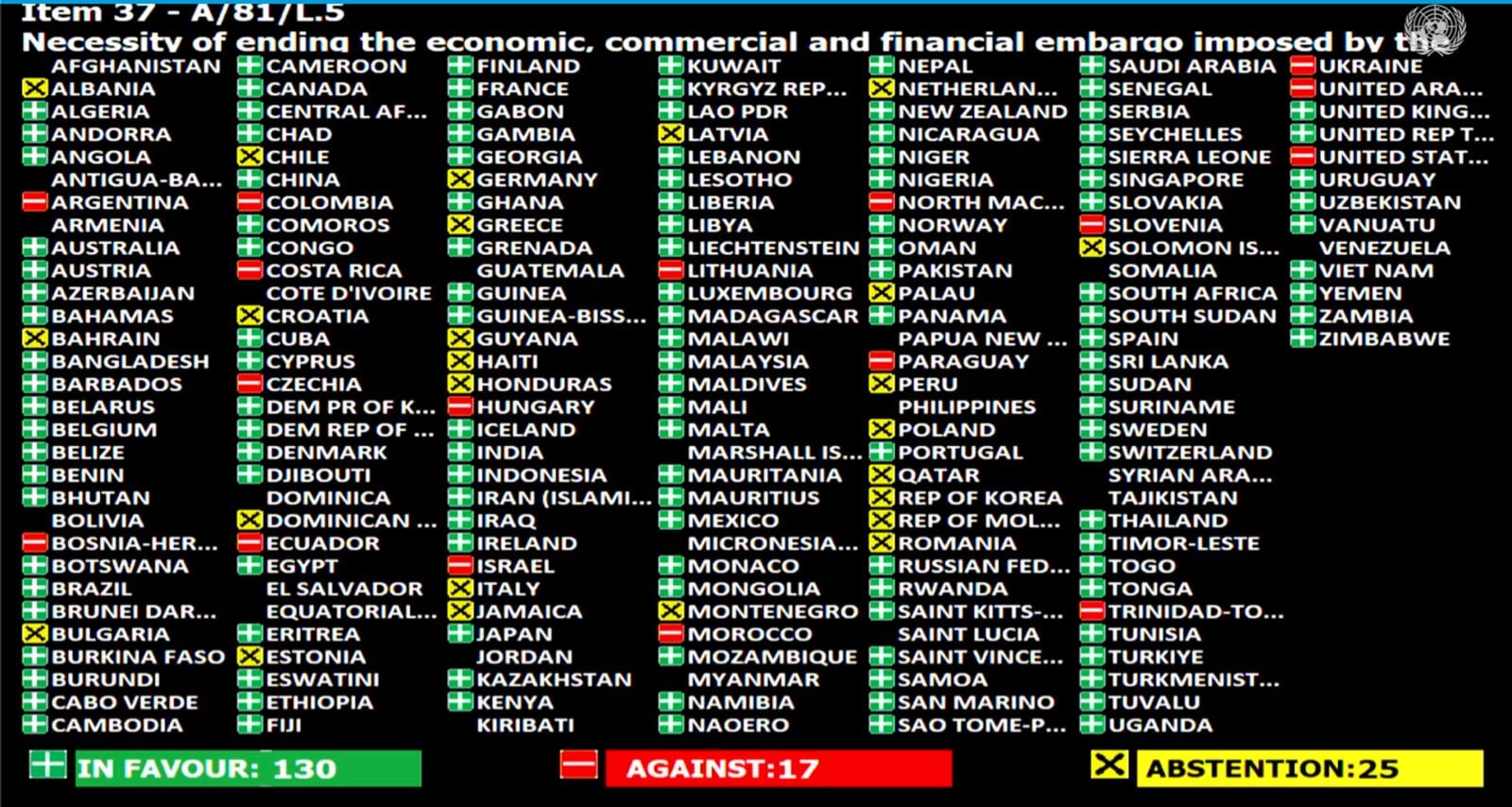
MIAMI — The Cuban regime suffered an unprecedented diplomatic setback at the United Nations on Wednesday: 17 countries voted against its annual resolution on the U.S. embargo, the highest number of opposing votes since it was first introduced in 1992. Although the resolution passed with 130 votes in favor, Havana lost the support of 35 countries compared with 2025, a reversal that tarnishes a vote it has portrayed for decades as an international victory.
The difference represents a 21.2% decline. Votes against the resolution increased by ten, while abstentions rose by thirteen. Another 21 countries did not cast a vote, compared with nine in the previous year’s vote.
The decline in support extended to governments that had backed the resolution in 2025. Colombia, Slovenia, Trinidad and Tobago, and the United Arab Emirates switched from voting in favor to voting against it. Costa Rica, Ecuador, Czechia, Lithuania, Morocco, and Bosnia and Herzegovina, which had previously abstained, voted against the resolution this time.
These countries joined the United States, Israel, Argentina, Hungary, Paraguay, Ukraine, and North Macedonia, which maintained their opposition. Among the countries that withdrew their support and chose to abstain were Chile, Germany, Greece, Italy, the Netherlands, Peru, South Korea, and Jamaica.
Havana retains a majority in favor of its demand, but the result diminishes the reach of one of its principal diplomatic platforms. The General Assembly has voted on the embargo since 1992. Its resolutions are nonbinding and do not, in themselves, alter U.S. sanctions.
The vote was preceded by a campaign by Washington to reduce support for the resolution and by an especially tense debate. On Tuesday, during an address by U.S. Ambassador Mike Waltz, Cuban representatives repeatedly interrupted his speech with points of order. Foreign Minister Bruno Rodríguez approached the podium as Waltz
demanded that he be allowed to continue. The session’s presiding officer was forced to intervene and warned that the meeting could be suspended.
Waltz had devoted part of his remarks to questioning the privileges enjoyed by Cuba’s ruling elite, displaying images of properties and luxury assets. Among them was Cayo Piedra, the enclave used by Fidel Castro and his inner circle. That same day, Secretary of State Marco Rubio posted an infographic of the site on X, accompanied by a message describing it as the private island of a corrupt regime.
The confrontation also extended beyond the exchange of speeches. Waltz alleged that a member of the Cuban delegation had attempted to pressure United Nations employees into cutting off the U.S. microphones. According to his account and a video he posted, the same official subsequently tried to intimidate a diplomat on his team who was recording the incident.
Tensions had been building since the previous week. On October 19, the U.S. mission organized an event at UN headquarters titled «Free Cuba: The Oppression Havana Hides,» featuring opposition figures and former political prisoners. Representatives of the Cuban government protested the event and engaged in a shouting match with U.S. officials.
Wednesday’s result maintains the General Assembly’s overwhelming opposition to the embargo but also reveals a loss of support for the resolution promoted by Havana amid the diplomatic confrontation.


