MIAMI, United States — The Armed Forces Business Enterprises Group (GAESA) appropriated approximately $100 billion between 2008 and 2022 through the export of medical services and the resale to third parties of oil supplied by Venezuela, economist Emilio Morales, president and CEO of Havana Consulting Group, said Wednesday during the forum GAESA: The Military Empire That Runs Cuba’s Economy, held at Florida International University (FIU).
Morales described GAESA as “a sophisticated criminal organization” and argued that the conglomerate currently controls 95% of the country’s finances and more than 70% of its economy, an estimate he had previously published in Cuba Siglo 21, where he wrote that “a military oligarchy controls more than 70% of the economy and 95% of the nation’s finances.”
According to his presentation, the largest diversion of funds comes from the export of healthcare personnel. Comercializadora de Servicios Médicos Cubanos (CSMC), which is under the Ministry of Public Health, provides the doctors, technicians, and nurses and signs contracts with the recipient governments, but the money is deposited in Banco Financiero Internacional (BFI), which is controlled by GAESA.
Healthcare professionals receive between 15% and 30% of the agreed-upon salary, depending on the destination country, while the remainder stays in the hands of the conglomerate: $70 billion between 2008 and 2022 whose ultimate destination, he said, is unknown. At its peak, Cuba had some 50,000 healthcare professionals working abroad, a figure that subsequently declined as a result of sanctions and the termination of contracts.
That system is now subject to U.S. sanctions. The State Department designated CSMC on July 23, 2026, pursuant to Executive Order 14404, in an action in which it stated that Cuban authorities confiscate “between 50 and 95% of the salaries paid by host countries” to tens of thousands of Cuban medical workers in more than 50 countries.
A month earlier, on June 23, the same department had designated BFI, describing it as the banking institution “absorbed by GAESA in 2016 that handles the vast majority of transactions involving foreign entities operating to and from Cuba.” GAESA had been designated on May 7, 2026.
According to Morales, money from the medical missions and remittances fueled hotel construction. Gaviota, GAESA’s tourism company, has 37,781 rooms and controls most of the country’s four- and five-star hotels. Its hotel network is valued at $18 billion, yet even in its best years it generated only between $800 million and $900 million in revenue, insufficient to finance that expansion without foreign investment. Citing statistics from the National Office of Statistics and Information (ONEI), Morales contrasted the $24 billion invested in hotels between 2008 and 2022 with the $1.751 billion allocated to public health during the same period.
The second major business operation he described was the resale of Venezuelan crude oil. According to the structure he presented, GAESA operates through Acemex Management Co. Ltd., headed by General Guillermo Faustino Rodríguez López-Calleja, brother of the conglomerate’s late chief, and through a network of more than 100 companies registered in Liechtenstein, Luxembourg, Cyprus, Hong Kong, Panama, and London. This structure operates 12 oil tankers—including the Sandino, Petión, Esperanza, Yara, and Vilma—that transport crude oil from Venezuelan ports and sell it to customers in Asian markets, primarily China and Singapore, with payments channeled through BFI and London-based Havin Bank Ltd.
“Cuba had never owned oil tankers before,” he said. Of the approximately $63 billion worth of oil Venezuela supplied to the island, he estimated that about $30 billion was diverted through this network. “It can be demonstrated that they have stolen more than $30 billion in oil.”
Morales placed the conglomerate’s center of power within the branch of the family descended from Raúl Castro Ruz: Major General Luis Alberto Rodríguez López-Calleja—who died of cardiorespiratory arrest on July 1, 2022—his grandson Raúl Guillermo Rodríguez Castro, his son Alejandro Castro Espín, his daughter Mariela Castro Espín, Italian-Cuban businessman Paolo Titolo, General Guillermo Faustino Rodríguez López-Calleja, and Óscar Pérez-Oliva Fraga, a great-nephew of Fidel and Raúl Castro, minister of Foreign Trade and Foreign Investment, who was appointed deputy prime minister in October 2025.
Among the principal operators, he identified Brigadier General Ana Guillermina Lastres Morera, Prime Minister Manuel Marrero Cruz, and Colonel Héctor Oroza Busutil, president of CIMEX in Cuba and Panama, Fincimex Panamá, and American International Services.
Morales also maintained that an affidavit from the corporation’s legal director, filed in litigation in New York, acknowledges that CIMEX Cuba—which owns gas stations, fast-food chains, real estate businesses, car-rental operations, and the remittance business—is a branch of CIMEX Panamá, created in 1978 by Colonel Antonio de la Guardia, who was executed by firing squad in 1989. If that is the case, he said, profits generated on the island belong to the shareholders of the Panamanian company. He added that the same group controls the commercial side of telecommunications, including deciding “who does or does not have internet access.”
The conference also served to present the Miranda Center for Democracy report Armies that Own Economies: Military-Commercial Capture in Cuba and Venezuela, which estimates that GAESA held at least $17.9 billion in assets in 2024, including more than $14.4 billion in bank accounts, and that it is run by “fewer than 15 individuals.”
The report estimates the conglomerate’s control over the Cuban economy at between 40% and 50%, below Morales’s estimate of 70%, and puts Venezuelan transfers to Cuba since 2000 at $63.8 billion, of which $57.4 billion corresponds to inflation-adjusted oil shipments.
The event was organized by the Jack D. Gordon Institute for Public Policy, FIU’s Cuban Research Institute, the Miranda Center for Democracy, and the International Republican Institute, with presentations by Brian Fonseca, Juan Antonio Blanco, Ernesto Romero, Sebastián Arcos, and Antonio Garrastazu.
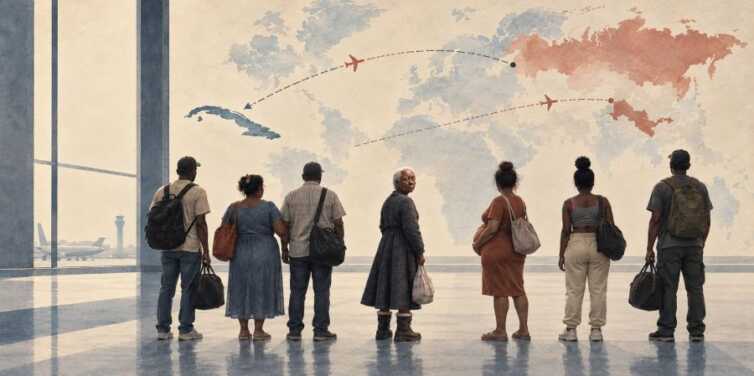
In his conclusions, Morales attributed primary responsibility for the crisis to this structure. He argued that the Cuban economy is going through the worst period in its history and that the cause is not the embargo or sanctions, but rather the system of governance that controls the country. The conglomerate, he added, has decapitalized the energy sector, agriculture, transportation, the sugar industry, and the drinking-water supply, and has pushed more than nine million Cubans below the poverty line while more than 2.5 million people have left the island over the past four years. “The [Communist Party of Cuba] is not the leading force of Cuban society, as the Constitution says,” he stated. “GAESA is.”