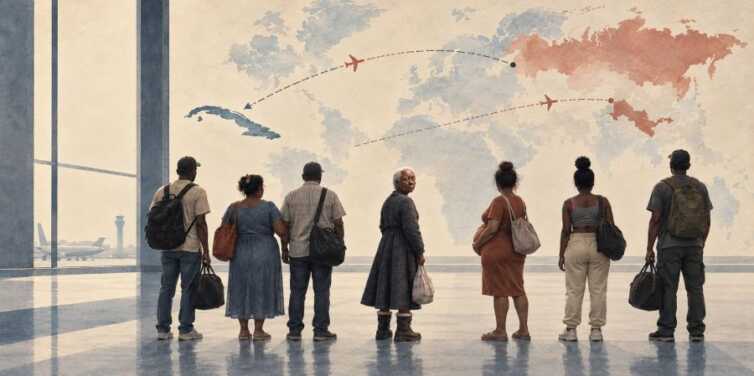
HAVANA — How could Cuba’s admission as a full member benefit the BRICS (Brazil, Russia, India, China, and South Africa)? The answer is obvious when one considers what recently happened with the British law firm PCB Byrne, which still harbors the naïve hope of collecting some £50,000 after being hired by the Cuban regime in the case involving the investment fund CRF I and ICBC Standard Bank. Or we could also recall the lawsuits for nearly $9 million that the Russian company Ark Technic has filed with a Moscow arbitration court against the Cuban Aviation Import Company (Aviaimport S.A.) and the Cuban Aviation Corporation S.A. (CACSA) over debts accumulated over the years that remain unpaid.
Those are the two most recent cases in the Castro regime’s history of nonpayment, but we still find laughable the patience of the Paris Club, the endurance and resignation—highly suspicious—of Spanish business interests, particularly Meliá Hotels International, and China’s puzzling persistence. China could probably pay each of its citizens $100 if it ever managed to recover everything it has poured into Cuba in the form of loans, millions in investments, and shiploads of donations. Or could it be collecting what it is owed in some other way?
Russia, too, has had to give up on collecting what it is owed on several occasions. But when it comes to BRICS, and given its experience, Moscow has withheld its support from its Caribbean dependent, which is now condemned to scour the world in search of someone unfamiliar with its long history of fraud.
If Washington, even at this point, does not know exactly what to do about Cuba—which, although it represents a national security threat to the United States, is also such an enormous disaster as a country that no one would want to shoulder the burden—BRICS is well aware that nothing good would come from allowing the PCC gang to become a full-fledged partner.
It would be like keeping an incinerator burning inside the group’s vaults, and even for Moscow and Lula da Silva’s Brazil, “solidarity” has very clearly defined limits when it comes to Havana, with its long “tradition” of accumulated debts, deferred payments, political blackmail, squandered money, fraud against foreign businesspeople, and other dirty dealings involving not only executed generals and dismissed ministers, but the Castro family itself, either directly or through third parties.
A former Cuban diplomat and intelligence officer told me a few days ago about operations in which he participated during the 1970s and 1980s, allegedly ordered and orchestrated by Fidel Castro for the purpose of obtaining quick and easy money from businesspeople and individuals of some political prominence who traveled to Cuba from Europe, Africa, and even the United States, not to conduct business but simply as tourists.
According to his testimony, individuals who were of interest to the country’s “leadership” were meticulously spied on during their stay. Recording devices were planted both in the places where they were staying and in locations they were expected to visit, and even in rental cars. Officers were assigned to them while posing as drivers, service staff, translators, cooks, and even sexual companions, always “looking for compromising information that could later be used to pressure them,” in his own words.
Thus, through practices involving blackmail and even the toleration of criminal activity, the former officer says, a number of political and commercial agreements were secured, as were substantial sums of money and even intelligence cooperation within influential groups in the United States.
Such was allegedly the case with certain European businesspeople and influential individuals who, in exchange for investing in Cuba or promoting investment there, were effectively allowed to operate above the law as a guarantee—whether by having sex with minors, using and trafficking drugs, smuggling tobacco, or hunting and fishing endangered species in areas designated as protected zones.
Prominent businesspeople appear in his testimony (something I may write more about later), along with lesser figures who nevertheless served the dictatorship in its efforts to ensnare bigger targets. There is also more than one chilling case, such as the better-known story of the Chilean member of Salvador Allende’s security detail who ultimately fell victim to fraud, but not before being deliberately married off to one of Commander Antonio Núñez Jiménez’s daughters.
But one of the most disturbing cases involved a group of South African army officers in 1987. Fidel Castro himself allegedly invited them to vacation in Varadero, providing them with all manner of pleasures and tolerating endless excesses, including the strangulation and killing of a young woman who, despite being a Ministry of the Interior cadet, had been recruited to pose as a prostitute. Everything was allegedly recorded in secret and subsequently used, up to the present day, to blackmail the South African officers implicated in the crime. This episode is also recounted in the novel Dulces guerreros cubanos (Sweet Cuban Warriors), written by Norberto Fuentes and originally published in 1999.
It was because of this personal experience that the former intelligence officer and diplomat with whom we spoke believed he could explain the millions of dollars that, with no apparent rationale, the regime has received from the South African military and government in recent years. According to allegations made by organizations both within the African country itself and beyond its borders, those blackmail relationships could explain the confidence with which Cuban officials have sought admission to BRICS, as well as their talk of “mutual benefits” (the latter perhaps uttered with the sarcastic smile the occasion calls for).
If there is one factor weighing heavily on the decision not to allow Cuba to join BRICS, despite friendships and expressions of solidarity, it is undoubtedly the country’s extensive history of failing to pay its debts. Even more important, however, is the conviction that what governs on this side is less a real government—or even a mafia—than a gang, and no one who genuinely wants to do business and see it prosper wants to deal with gangsters.